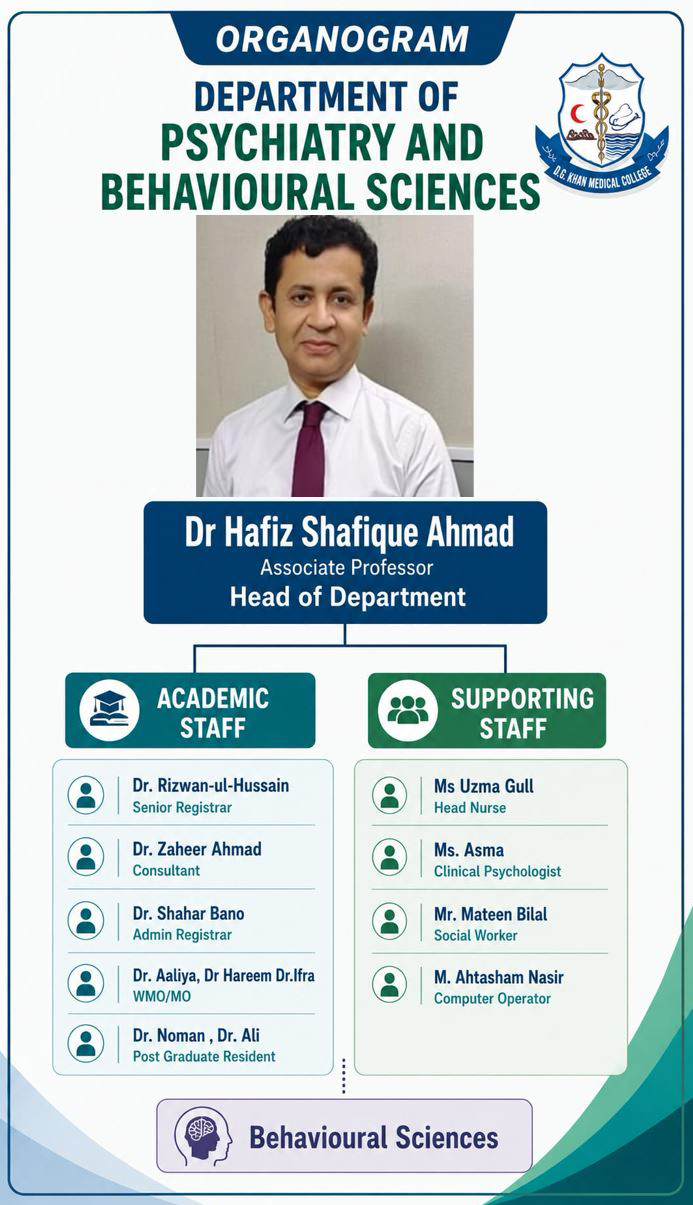
The Department of Psychiatry & Behavioral Sciences
The Department of Psychiatry & Behavioral Sciences is a foundational pillar of medical education, dedicated to exploring the intricate mechanics of human behavior and mental health. Under the leadership of Dr. Hafiz Shafique Ahmad (Associate Professor, FCPS Psychiatry) the department introduces students to the complex psychological, social, and biological systems that influence human conduct, providing the essential groundwork required for every future clinician.
Established and continuously evolving to meet modern medical standards, the department has been actively shaping healthcare education, notably advancing its clinical and academic integration since 19 January 2019.
A comprehensive, deep-rooted knowledge of the normal and abnormal functions of the human mind is indispensable for a doctor. The department’s curriculum is designed to teach how different behavioral principles, psychological traits, and neurological functions work together to maintain mental well-being, transitioning students from theoretical behavioral science to clinical realities.
Educational Methodologies & Clinical Facilities
To bridge the gap between core concepts and medical practice, the department utilizes a diverse blend of modern educational strategies and practical, hands-on clinical exposure.
Core Teaching Modalities
Expert Lectures: Interactive sessions delivered by senior, highly experienced faculty members to lay robust theoretical foundations in psychology and behavioral medicine.
Small Group Discussions (SGDs) & Tutorials: Focused, student-centric sessions designed to clear complex behavioral concepts, promote critical thinking, and encourage peer collaboration.
Clinical Integration: A curriculum structured with a special emphasis on the clinical and practical applications of psychiatric principles in real-world medicine.
Fully Functional Psychiatry Ward
The department features a fully equipped, modern psychiatry ward where students transition from textbooks to hands-on learning. Under expert supervision, students utilize advanced diagnostic tools, interview techniques, and therapeutic environments to observe psychiatric phenomena firsthand, mastering the practical skills essential for managing mental health crises, inpatient care, and outpatient consultations.